Article

Back To The Basics V – Aparigraha

@meganzopf

My dear Yogis and Yoginis,

This weeks theme is called Aparigraha
(Non-hoarding, non-attachment)

“It is okay to have things, but do not let them have you. Everything in life is rented. When stuck in the world of the little self, one attaches to feelings, people and things.
When immersed in the Big Self all neediness dissipates.”
~ Alan Finger 
(How to expand the little self to merge into the big self)


“It is the preoccupation with possessions, more than anything else, that prevents us from living freely and nobly.”
~ Henry David Thoreau


Aparigraha on the mat
It is on our mat—with our breath—that we begin to learn the lesson of aparigraha. During our asana practice, we have the opportunity to observe how fear and insecurity can restrict our life force, through our tendency to hold the breath in challenging moments.
Whereas through breathing deeply, we are able to flow smoothly from one posture to the next and enjoy the transitions and challenges that come with it.

Mat practice also lets us observe whether we are attached to achieving a certain level of success in our asana practice, in terms of how it will make us look or feel, or if we are clinging to our fears and holding ourselves back from giving 100% to the enjoyment of the posture.

5 ways of incorporating aparigraha into daily life
– Downsize, declutter, and practice minimalism
– Share with gratitude
– Forgive and let go
– Prioritize self-care
– Share and give away your rights too

Practicing aparigraha and living a life of simplicity does not mean that we don’t care for our loved ones or that we deprive ourselves of the comforts, pleasures, and joys of life. Neither does simplicity mean poverty. On the contrary, aparigraha frees us up to be immersed in
appreciation and reverence for our lives and relationships.
We are asked to let go of the craving and clinging, but not the
enjoyment. If you feel a lack in any area of life, immediately start
practicing aparigraha. It will not only bring abundance and freedom but will also nurture sharing and caring.

In short, go with the rhythm of life, and enjoy the ebb and flow of the moment. Take only what you need. Love with all of your heart.
But know that the only constant factor in life is change and to
experience life to the fullest, we need to stay present. Let go. Breathe.
~ Art of Living

Monday 12.09.
Free Flowing Breath
Slow Flow

Wednesday 14.09.
Smoothly Flowing from Asana to Asana
Continues Flow

Thursday 15.09.
Open Theme
Yogis Choice

Friday 16.09.
Enjoying Transitions & Challenges
Flow

A week of letting go with the breath leading!

Love,

Nicole

Article

Back To The Basics IV – Brahmacharya

one of Ahyoka’s cravings

My dear Yogis and Yoginis,

This week I want to share different thoughts on the forth yama
Brahmacharya.

“Every three minutes mother earth desires to create. A tantric yogi must channel this energy for divine purposes. Make every thought, word and action sacred, avoiding fantasies that develop the little self’s world and keep one from living in the moment.”

~ Alan Finger 
(How to expand the little self to merge into the big self)


“Brahmacharya – the moderation of the senses – is one of the key
practices yoga offers for managing sensory cravings. It is the fourth of five yamas, or restraints, which help us cultivate self-awareness and transform habits that are out of sync with our spiritual aspirations.

Literally, brahmacharya translates as “walking in God-consciousness.” Practically speaking, this means that brahmacharya turns the mind
inward, balances the senses, and leads to freedom from dependencies and cravings.
Yogis tell us that when the mind is freed from domination
by the senses, sensory pleasures are replaced by inner joy.

Brahmacharya practices range from the very structured to the highly intuitive. A person who craves candy bars may need to impose a limit of one per day. Yet that double-decker chocolate cheesecake might be just right for a special occasion. In a world overwhelmed by stimuli, making wise choices about the books and magazines we read, the movies we watch, and the company we keep will help us conserve
energy and keep our mind focused and dynamic. Being moderate in sensory activities so that we don’t dwell on them, staying committed and faithful to one partner in a relationship that is mutually supportive – this is the middle path of brahmacharya.” 

~ Yoga International

Montag 05.09.
Flow into your Happy Place
Flow

Wednesday 07.09.
Heart-Breath Connection
Slow Flow

Thursday 08.09.
Open Theme
Yogis Choice

Friday 09.09.
Rock and Roll Flow
Flow

What are your cravings?

Love,

Nicole


Article

Back To The Basics III – Asteya

@Coffee

My dear Yogis and Yoginis,

This week is about Asteya – non-stealing, non-possessiveness

“Do not steal possessions, emotions or time from others.
People steal when they feel incomplete. Find joy in what you have and feel the completeness of the Big Self.”

~ Alan Finger 
(How to expand the little self to merge into the big self)

INTERPRETATIONS OF ASTEYA AND HOW IT’S APPLIED

“Sure, you’d probably agree that most human beings aren’t thieves. And while the surface level example of asteya (not stealing material possessions from other people or places) is usually easy enough to
follow, there are other forms of stealing that can be a bit more
challenging to always uphold. 

You may even be unknowingly stealing in your daily life:
taking credit for someone else’s work, hoarding more than you need, unintentionally taking things from work (pen, notepad).
(Hey, if you didn’t know, you didn’t know — no judgment.
We can all learn and improve.) 

There are many layers to asteya and understanding how to actively practice can be beneficial to both your yoga practice and
your daily life. 

When combining non-stealing with yoga, remember to give yourself enough time (before, during and after) to wholeheartedly dedicate to your practice. For example, if you attend a group yoga class, being late (and all of the disruption that comes with it) is stealing time and peace from yourself, your yoga teacher, and your fellow yogis.

While on the yoga mat, moving from one asana (pose) to another, it’s common to become distracted by others in the class: one person is
incredibly flexible; someone else is flowing through each pose with her eyes closed. It’s impressive and sometimes intimidating. 

This awareness may produce thoughts of envy and insecurities about your own abilities. That insecurity may push you to do more than what your body can handle because you desire to look a certain way
in a pose.

Pushing yourself beyond your edge for the purpose of perfection is not serving your needs and can result in unnecessary pain and suffering due to injury. Concerning yourself with what others are doing only distracts you from being in the present moment and feeling the
beautiful complexities within your own body — it’s stealing your own peace of mind and enjoyment of the practice.

The fact is, every human being is unique and most will look differently in poses. Show yourself some love and compassion by setting healthy boundaries of thought and allow yourself to move through asanas
(and life) at your own pace.”

~ Brett Larkin Yoga
(click the link if you would like to read more)

Monday 29.08.
Peace of Mind
Flow

Wednesday 31.08.
Playing the Edge
Flow

Thursday 01.09.
Open Theme
Yogis Choice

Friday 02.09.
Eyes Closed
Slow Flow

Still working on not stealing your time by not finishing class on time! 🙂

Love,

Nicole

Article

Back To The Yoga Basics II- Satya

My dear Yogis and Yoginis,

This weeks Yama is Satya – non-lying, truthfulness.

“Lying creates confusion and the inability to perceive guidance from the Big Self. The little self gets trapped in lies. Speak, think and act truthfully and you will have clarity in life.”
~ Alan Finger
(How to expand the little self to merge into the big self)


The Four Gates of Speech
As a guide, the Four Gates of Speech, which evolved from the third action in the Noble Eightfold Path of Buddhism, offer a litmus test for delivering spoken words.

Are they true? 
Beyond the factual verity of your words, they must be spoken with
intention and clarity. A lie, no matter how trivial, disconnects us from higher consciousness and creates an entry point for self-doubt – if we know we are capable of lying, we lose the ability to trust ourselves and our instincts.

Are they necessary? 
Consider whether your words add value to a given situation or whether it might be prudent to listen instead.

Is it the right time? 
Take a moment to understand whether the person you are speaking to is ready to receive your words. Be patient if the timing isn’t right, your message will land most gently when it is.

Are they kind? 
Finally, and perhaps most importantly, be kind. Ahimsa is offered as the first yama to be observed above all others and the last gate of speech as a final checkpoint before we are cleared to speak.
Words without kindness are unconstructive, even when engaging in
challenging conversations. If your words cannot be delivered from a place of kindness, go back inside and evaluate how you might identify words that better reflect your true nature.
~ Laura Hand
(Excerpt from “Satya: Truth in Practice”)
https://www.gaia.com/article/satya-truth-practice


The Three Universal Truths:
1. Everything is impermanent and changing 
2. Impermanence leads to suffering, making life imperfect
3. The self is not personal and unchanging

The Four Nobel Truths:
1. All life involves suffering
(the Truth of Suffering)
2. Suffering is caused by desire and attachment
(the Origin of Suffering)
3. Desire and attachment can be overcome
(the Truth of Cessation)
4. The way to overcome them is by the Eightfold Path
(the Truth of the Path)
~ www.bbc.co.uk

Monday 22.08.
Heart & Lungs
Slow Flow

Wednesday 24.08.
Open” Twists
Flow

Thursday 25.08.
Open Theme
Yogis Choice

Friday 26.08.
Closed” Twists
Flow

A lot to worth to think and contemplate about, isn’t it?!

Love,

Nicole

Article

Back To The Yoga Basics – Ahimsa

hand symbolizing ahimsa

My dear Yogis and Yoginis,

The general known translation for Ahimsa is non-violence,
non-injury. I just read Ghandi translated it as love.

Way back in time I did my yoga teacher training in NY; it was taught in the Buddhist tradition. During that time I also went to another
studio to take class. It was called “Yoga Zone”, then Be Yoga and later ISHTA where they taught tantra yoga. Most yoga studios in those days were rather simple and purpose fulfilling. At the upper east side where life and the stores were more upscale and this studio was placed, it didn’t quite fit the criteria.

I remember going there once a week in the morning when the owner Alan Finger would teach class.
The room packed with people and him sitting on his podium looking like Santa Claus with his rosy cheeks, white hair and beard and genuin smile on this face. Right and left of him were these gorgeous looking young women seated to assist him for the asana part of the class.
I was amazed and surprised to see the first rolls of people filled with dedicated older ladies from the upper east side. So with other words a very mixed crowed.

He would lecture the first 20-30 min. on different subjects.
I liked how he explained things and made them for everybody
approachable. One of the teachings from him stayed with me till now. It is the one of the Yamas (restrains) and Niyamas (non-restrain), you all probably have heard of them or maybe even studied them.

“Refrain from hostility in speech, thought and action.
Practice non-harm to yourself, to others and to things. Violence and hostility strengthens the ego, keeping one ignorant of the Big Self. Practice gentleness, compassion and unconditional love.”
~ Alan Finger
(How to expand the little self to merge the big self)

I would like to share with you the next weeks the other Yamas as well and maybe you can take the time to reflect and see how it applies to your life or could improve the quality of it.

Monday 08.08.
Revitalize the Spine
Flow

Wednesday 09.08.
Flow into Balance
Flow

Thursday 10.08.
Open Theme
Yogis Choice

Friday 11.08.
Side-Body Opening for Easier Breathing
Slow Flow

~~~~~~~~~~~~

Monday 15.08.
How do you want to feel
Flow

Wednesday 17.08.
Suspended & Supported
Slow Flow

Thursday 18.08.
Open Theme
Yogis Choice

Friday 19.08.
Moving Stagnant Energy
Flow

I hope you enjoyed the little excursion in to my yoga past 🙂
Come and create some peace for yourself and the world!

Love,

Nicole

Article

Sympathy Is Easy – Empathy Connects

Lady GG

My dear Yogis and Yoginis,

I was recently part of an online class and it was said that humans are the only creatures that can feel empathy at will. I think that is a very powerful statement/fact.

It is easy to feel sympathetic. I think this response is mostly influenced and lead by the brain that’s why also judgment takes place. Trying to come up with solutions for the other person or to finding something positive to counterbalance the suffering the other one endures.
It creates a gap and distance between you and the other person.

When being empathetic you can feel and emotionally understand where the other person is at. Sometimes all what needs to be done,
is being simply there and holding that space even if it feels
uncomfortable for you not to be able to do anything or
to have a solution.

All of this is most likely nothing new to you and could be of course much more explained and explored. This is a great little video showing the difference: https://www.youtube.com/watch?v=KZBTYViDPlQ

It is said that one can learn to be more empathetic. But if we train
ourselves how we can be better reacting and be more supportive next time, it is again approached mainly by the intellect.
So that made me think that everything actually starts and ends with oneself again.

How much empathy are you really allowing yourself to feel when you are “in a dark” place for yourself?
In this world or time we are not much encouraged to have or
experience the feelings of suffering.
Isn’t it more like – move on, get over it, there is no time or space for this, what will the people think or say?

I believe you can only feel true empathy to the extend you allow
yourself to feel it in your own heart and life.
This doesn’t mean one resides in that space “forever”, but it needs to be acknowledged and felt.
Then it can leave your body and not haunt you later.

No better place to practice that then in your safe spot, your yoga mat and in your all embracing online yoga community 🙂

Monday 01.08.
Caring Breath
Slow Flow

Wednesday 03.08.
Spacious Heart – Open Hips
Flow

Thursday 04.08.
Open Theme
Yogis Choice

Friday 05.08.
Grounding Safety
Flow

Can’t wait to see you beautiful beings in my class!

Love,

Nicole

Article

Love Is A Choice & It Transforms Everything

woman with dog in forrest
@quantum_noursihment

My dear Yogis and Yoginis,

I would like to share with you some thoughts about love expressed by different people. Going beyond the usual romantic and conditional love we are mostly surrounded by.

“Love is one of the universal experiences and also one of the most mysterious. That’s because it means different things
to different people.

There’s a power that can be found in a very precise kind of love that’s already within us – it’s something we must acknowledge,
embrace, awaken, and accept in our own lives.
This is what the wisdom of our ancestors said as well.
There’s something within us, and if we can embrace what already
exists, it heals us and transcends the great suffering in our lives.
If we don’t accept it, sometimes we succumb to the pain and suffering that comes from the inability to love and the inability to love
ourselves.

The key is that the role we allow love to play is a choice.

We will all have hurt because all things are impermanent, personal tragedies and suffering – the choice is what do we do with the pain and suffering.
It’s about our ability to awaken a force that already lives within us, to find the strength from that force to give new meaning to those hurts, and when we do that, we find the highest levels of our
personal mastery.
Often, the people who are willing to love and are willing to love on the deepest levels are those who have been hurt deeply and learned to transcend the hurt. That power frees us.

What are the emotional blocks, the psychological dams that we’ve put up?
When we want to love, our job is to find everything about ourselves that is not love. When we do that, all that’s left is love.
The difference between our primal capacity to love and the
perceptions of love that we hold today is the distortion that brings us suffering, disappointment, and fear.

When we create heart-brain harmony, we’re also opening a channel to move beyond judgment and the polarity of the mind. In the polarity organ, you are always going to have good/ bad, right/wrong,
success/failure, worthy/not worthy. This is the way of thinking that creates the suffering.

Shanti Ishta (Cherokee) – “The single eye of the heart.” Discerns right and wrong without the judgement of right and wrong.”

~ Gregg Braden (The Wisdom Codes)

“Strive to make your love greater than your need, and let love be the most powerful force in your life. Then nothing can overcome you.”

~ Kate McGahan, Hospice counselor

“Your task is not to seek for love but merely to seek and find all of the barriers within yourself that you could build against it.”

~ Rumi

Monday 25.07.
Overall Love
Flow

Wednesday 27.07.
Loving Kindness
Slow Flow

Thursday 28.07.
Open Theme
Yogis Choice

Friday 29.07.
Self-Love
Flow

I truly love our online yoga community 🙂

With gratitude,

Nicole


Article

Choosing Trust Versus Control

My dear Yogis and Yoginis,

I was contemplating on my walk today about how much we as humans want and like to control everything and everyone incl. ourselves.
As long we are under control it feels empowering and everything seems okay. But then there is the fear of loosing control or the
frustration of not getting it under control.
We set ourselves up for self made suffering and struggle that brings a high level of stress with it. Control gives a great sense of power and loosing it an equally strong emotion.

Isn’t it an illusion in first place to have things under control?
And isn’t the need of control a lack of trust?

What if we would shift more often our urge to control to observing ourselves and finding awareness that we begin to trust the flow of life.
We might gain more insight, reduce a whole lot of stress and feel more in flow with what life has to offer. Shifting from the duality of the brain that tends to bring the suffering to the all embracing heart.

I would like to share with you what Krishnamurti has to say from the yoga point of view.
“Yoga does not mean merely keeping your body healthy, normal, active and intelligent. The word in Sanskrit means ‘join together’ – joining the higher and the lower – which is the tradition.

There are various forms of yoga, of which the highest form is called Raja Yoga, the king of yogas. That way of living was concerned with physical wellbeing and, much more, with the psyche. There was no discipline, no system, nothing to be repeated day after day.
It was to have a brain that was in order, that was all the time active but not active in chattering. It was to have a very deeply ordered moral, ethical and disciplined life, not based on taking various vows.

That was the real meaning of the highest form of yoga. Although the body was kept healthy, it was not of primary importance.
What was of primary importance was to have a brain, a mind, a state of wellbeing that was clear and active. Not active in the sense of
physical movement, but a brain in itself active, alive, full of vitality.

The highest yoga is not to be taught to the casual; it is something that you do, perhaps every day, to have perfect awareness of your body.
You watch your body so that it does not make any movement or
gesture that is not observed. There is no unnecessary movement of the body, but it is not controlled. That is where the difference is. 

Perhaps you consider yoga something to be practised day after day to have a muscular body. It is not that at all. It is something you live all day long, watchfully observing, being clear about. “

~ Krishnamurti (from the book Meeting Life)

Monday 18.07.
Spine Awareness
Flow

Wednesday 20.07.
Thought Awareness
Flow

Thursday 21.07.
Open Theme
Yogis Choice

Friday 22.07.
Body-Breath Observation
Slow Flow

Give your body/mind the attention it deserves!

Love,

Nicole

Article

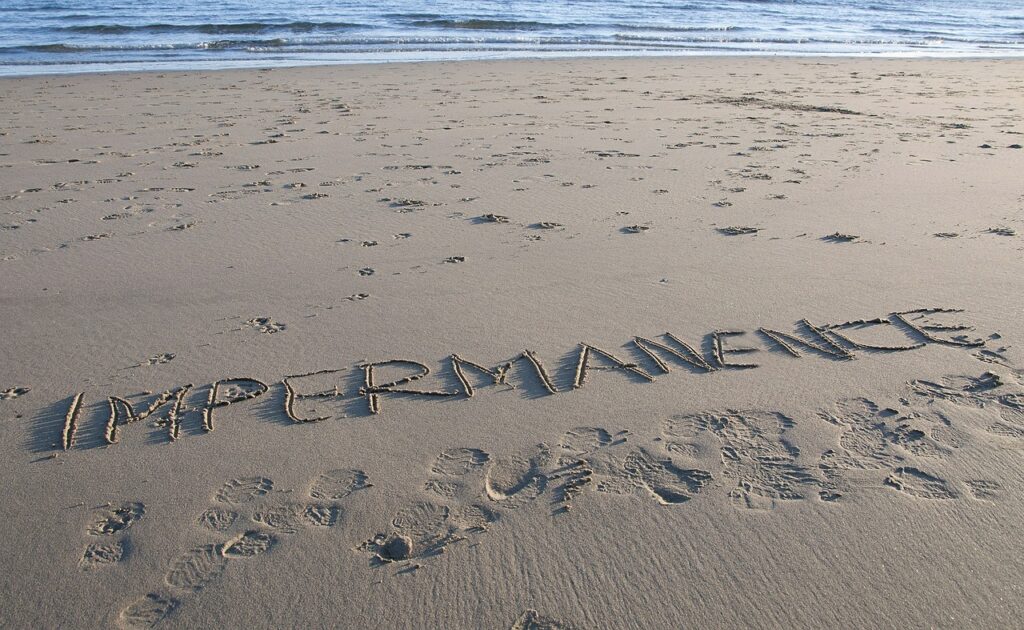
Embracing Impermanence

Word written in the sand of a beach

My dear Yogis and Yoginis,

I am still immersed in “The Wisdom Codes” and would like to share with you some insights from it concerning impermanence and
the suffering that results from it.

“Change is happening all around us. We all have loss in our lives. Sometimes we don’t even recognize that it’s happened.
Other forms of loss are so great that the whole world stops when those things happen to us – the loss of a loved one or a job. Loss means
different things to different people.
– We, as a society, are rarely given permission to mourn what is past. It’s doesn’t have to be a deep expression of grief – it’s the
acknowledgement of the loss that begins to free the chemicals so they can metabolize and allow us to move forward.
– Once we have a loss, we can’t un-lose it. We have it, and the only way out of it, once it happens, is to go through it – not discount it, not sweep it under the carpet.
– When we have an experience of trauma without the tools to heal or reconcile, we create neuropeptides, which want to leave the body, and when we don’t hold them in, they will move out of our bodies in the ways that chemicals always move out of bodies – they pass through.

What do those losses mean to our bodies?
Every emotion we have creates a chemical in our body.
The joyous emotions are rarely the problems, but the traumas can cause a lot of problem.
– When we have an experience without the ability to reconcile that experience, we contract, constrict, and lock it down in our bodies. That chemical cannot then metabolize and move. So, we store it in the organs, tissues, or body system that we associate with the trauma – heart, lungs, reproductive system. They stay there until we are ready to deal with them, but they don’t know about time, and they begin to create conditions in the body that let us know that they’re there:
inflammation or something that elevates to some else that lets us know we have the hurt, fear, or loss that we have never reconciled.
– The key is to embrace it and let it pass through and out of the body

– We suffer because we expect that someone or something will
continue to exist in a way that meets our expectations. We enter into a relationship, job, or state of health – consciously or subconsciously, we expect that things are going to remain the same as they were, and if they don’t, it’s the difference between what was and what is in the
moment that is the source of our suffering.”
~ Gregg Braden

Monday 11.07.
Each inhale is a new beginning
Slow Flow

Wednesday 13.07.
From the roots to the heart
Flow

Thursday 14.07.
Open Theme
Yogis Choice

Friday 15.07.
Acknowledgement – Gratitude – Letting Go
Flow

Let go of the old and welcome the new 🙂

Love,

Nicole

Article

Harmonizing The Heart & The Brain

Jill wellington

My dear Yogis and Yoginis,

As you know my writings are always about things that are present in my life at that moment. This is my way of sharing my inner self with you. Even though I can only touch the surface of the subjects I hope it inspires you to look deeper into one or the other.

Here are some insights about our heart:
– There are about 40,000 specialized sensory cells in the human heart called sensory neurites, these cells see you apart from all other forms of life in the world today.
– Neurites are essentially brain-like cells that function in the heart very similar to the way that neurons function in the brain.
– These Neurites learn, think and experience independently of the
neurons in the brain.
– Every Experience that you have, you’re essentially having in two places: in your brain and in your heart.
– It’s important to access both of these networks for our healing.
– The arteries and the valves are all regulated through the neurites.
– They respond to your perceptions, the way you feel about your
relationship to the world.
– This allows you to self-regulate and to choose your response to the world around you.
– The neural network in the heart is where we access our heart
intelligence and our deepest states of intuition.

– We’re the only form of life that can harmonize two organs into a single potent system in your lives.

The better you know yourself, the less you rely on the outer world for balance.
~ Gregg Braden (The Wisdom Codes)

This week will be an other glimpse of what you could be exploring at home on your own; our main focus will be on continuing to get to know ourselves better 🙂

Monday 04.07.
Balancing your effort
Flow

Wednesday 06.07.
Aligning Heart & Brain
Organ Flow

Thursday 07.07.
Open Theme

Friday 08.07.
Flow into Harmony
Continuous Flow

Let’s harmonize!

Love,

Nicole

On this website we use first or third-party tools that store small files (cookie) on your device. Cookies are normally used to allow the site to run properly (technical cookies), to generate navigation usage reports (statistics cookies) and to suitable advertise our services/products (profiling cookies). We can directly use technical cookies, but you have the right to choose whether or not to enable statistical and profiling cookies. Enabling these cookies, you help us to offer you a better experience.